What ChatGPT actually did
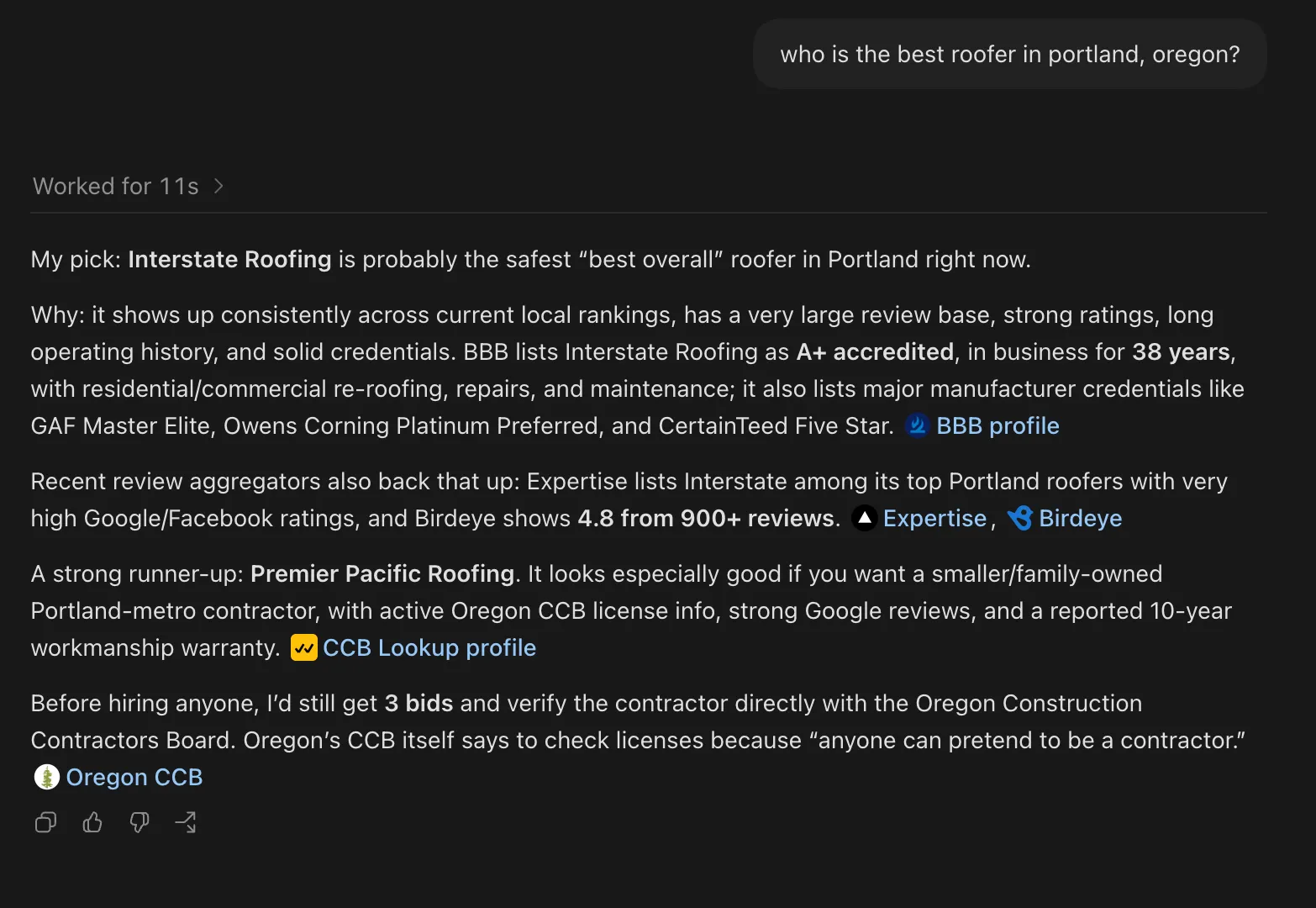
Asked "who is the best roofer in Portland, Oregon," ChatGPT named Interstate Roofing. Its reasons, in its own words: consistent appearances across current local rankings, a very large review base, strong ratings, a long operating history, and solid credentials. It cited the BBB profile for A+ accreditation and 38 years in business, listed manufacturer certifications from GAF, Owens Corning, and CertainTeed, pointed to an Expertise listing, and quoted a Birdeye figure of 4.8 stars from more than 900 reviews. For a runner-up it named Premier Pacific Roofing and cited the Oregon CCB license lookup. GEO for roofers has the roofing-specific steps that follow from it.
Asked "who is the best plumber in Portland," it named Service Plus Plumbing: 5.0 on Google from 933 reviews, 4.8 on Yelp, 4.9 on Angi, BBB A+ with no complaints, and a list of services pulled from the BBB page. Its sources were Yahoo Local, BBB, and Angi. Then it added a caveat. Service Plus is closed on weekends, so for an after-hours emergency it pointed to Pro Drain or Cornel's, which are open 24 hours. GEO for plumbers has the hours fix that answer points to.
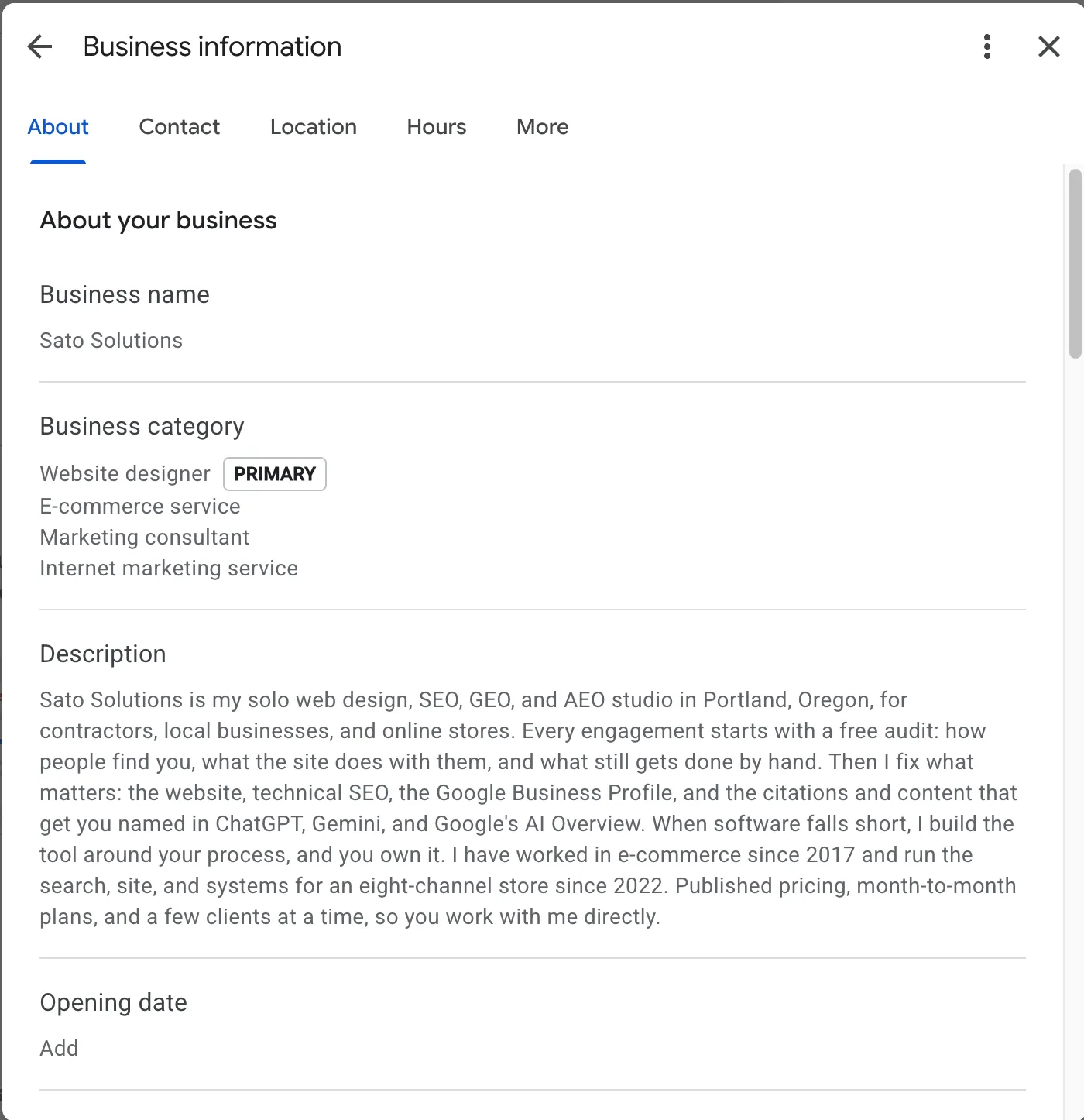
Neither business holds a spot in Google's map for those searches. Both were chosen from records other people keep. Getting onto those records is the GEO half of my SEO, GEO, and AEO services.
The rule underneath
ChatGPT names the business it can verify from outside that business's own website. Read both answers again and the criteria are the same three every time. That is the difference between GEO and a ranking, and GEO vs SEO vs AEO draws it in full.
- It can confirm you exist and are legitimate. A state license record, a BBB profile, years in business. These came first in both answers. A website alone does not do this, because a website is a claim the business makes about itself.
- It can see quality from several sources that agree. Google, Yelp, Angi, Birdeye, Expertise. The roofer answer leaned on "consistent across sources." One platform with a high rating is a data point; four that agree is evidence.
- It can match you to the request. Services, service area, hours, warranty, certifications. The plumber answer read the hours and changed its recommendation for emergencies. The roofer answer noted metal roofing credentials. If the fact is not written down somewhere it can read, it cannot match you to the person asking.
The week of work
Everything below is free or close to it, and none of it is technical. The order matters because the later steps are read in light of the earlier ones.
- Monday: make the facts agree. Write down your name, phone, address, hours, service area, license number, and year founded. Then check them on your site, your Google profile, Yelp, Angi, BBB, and the state license lookup. Fix every disagreement. Hours especially: if you answer at night, every listing has to say so.
- Tuesday: get on the records. Claim or create the BBB profile and apply for accreditation. Confirm the state license record is current and shows the right business name. Claim Yelp and Angi. Check Yahoo Local, which the plumber answer cited first and which most businesses have never looked at.
- Wednesday: write it down on your site. A page per service and a page per city, each with the process, the timeline, a price range, the warranty, and the questions people ask. Put the license number, insurance, hours, and certifications in text on the site. The engine repeats what it can read.
- Thursday: collect the credentials. Manufacturer certifications, association memberships, the chamber, supplier installer directories. Each is a third-party page that says you are who you say. The roofer answer listed three manufacturer programs by name.
- Friday: build the review habit. A text after every completed job with the link, at the hour people actually respond. Ask for specifics: the service and the neighborhood. A review that says "replaced our roof in Sellwood in three days" gives an engine something to quote.
- Then: measure. Ten prompts your customers would ask, run in ChatGPT, Gemini, and Google's AI Mode on the same day each month from a signed-out browser. Record who is named and what is cited.
What does not work
Some of what is being sold as "AI optimization" does nothing, and some of it hurts.
- Keyword stuffing. The research that named the field tested it. Adding keywords did nothing to visibility in generated answers. Adding citations, quotations, and statistics raised it by up to 40 percent.
- Pages written for the AI with no facts in them. A page that says you are the best roofer in Portland without a license number, a price range, or a service list gives the engine a claim and nothing to check it against. It moves on.
- Bought or seeded reviews. The engines read several review sources and compare them. A count on one platform that the others do not support reads as noise.
- Telling ChatGPT about yourself. A conversation does not change the model or its sources. What you type in a chat window stays in that window.
How to check that it worked
Ask the questions your customers ask. "Who is the best roofer in Portland" is one prompt. "Who should I call about a roof leak in Beaverton on a Sunday" is a better one, because it tests hours, area, and emergency service at once. The spreadsheet layout for tracking AI visibility keeps the months comparable.
Run the same list monthly, signed out, in three engines. Answers vary between runs, so count how many prompts name you across the whole list rather than reacting to any single answer. When a competitor is named, read the sources it cited. That list is your next week of work. The free consultation runs the prompts and reads the sources for you.
Frequently asked questions
- Can I pay to be recommended by ChatGPT?
- There is no placement to buy inside the recommendation. The names in the answer come from the sources the engine reads: license records, BBB, review platforms, directories, and your own pages. The work is getting onto those sources with facts that agree.
- Does ChatGPT read my Google Business Profile?
- It quoted a Google rating and review count for one plumber, and cited Yahoo Local, BBB, and Angi for the rest. Keep the profile complete; the engine reads the number even when it does not cite the page. Beyond that, It cited BBB, the state license lookup, Angi, Yahoo Local, Birdeye, and Expertise. Your Google profile matters for the map. For ChatGPT, the same facts need to exist on the records it does read.
- How long until ChatGPT recommends my business?
- Fixing disagreements and getting listed on BBB and the state lookup can change answers within weeks, because those are read first. New service and area pages take a few months to be trusted. Measure monthly and expect the count of prompts that name you to move in steps.
- Does this work for Gemini and Google AI Mode too?
- The inputs are the same. Google's answers lean harder on the Google profile and its reviews, so keep that complete as well. The monthly prompt list should run in all three, because a business can be named in one and absent from another.
- What if a competitor is named instead of me?
- Read what the answer cited. In Portland it was BBB, the CCB record, Angi, Yahoo Local, and review aggregators. Get on each source the competitor is on, with facts that match yours everywhere else, and re-run the prompt next month.
Want to know what it says about you?
The consultation runs the prompts for your trade and shows you who gets named, what was cited, and the week of work that changes it. The consultation is free, and the pricing is published.