Three acronyms, one question
The question behind all three is the same. When someone needs what you do, does your name come up?
SEO, search engine optimization, is about the list: the map with three businesses on it and the blue links under it. AEO, answer engine optimization, is about the box: the featured snippet, the People Also Ask panel, the AI Overview at the top of the page, the thing a voice assistant reads out. GEO, generative engine optimization, is about the answer itself: what ChatGPT, Gemini, Perplexity, or Google's AI Mode writes when someone asks it for a plumber instead of searching for one.
They overlap more than the acronyms suggest. The table is the short version. All three are one engagement in my SEO, GEO, and AEO services.
| SEO | AEO | GEO | |
|---|---|---|---|
| Where you show up | The map and the blue links | The answer box above the links | Inside an answer an AI writes |
| What decides it | Relevance, authority, proximity, reviews | A clear answer to a clear question | What the whole web says about you, and whether it agrees |
| What you work on | Pages, profile, citations, speed | Question headings, direct answers, FAQ schema | Specific pages, consistent facts, third-party mentions |
| How you measure it | Rankings, calls, forms | Snippets won, questions answered | Prompts you are named in, referrals from AI tools |
What SEO still does
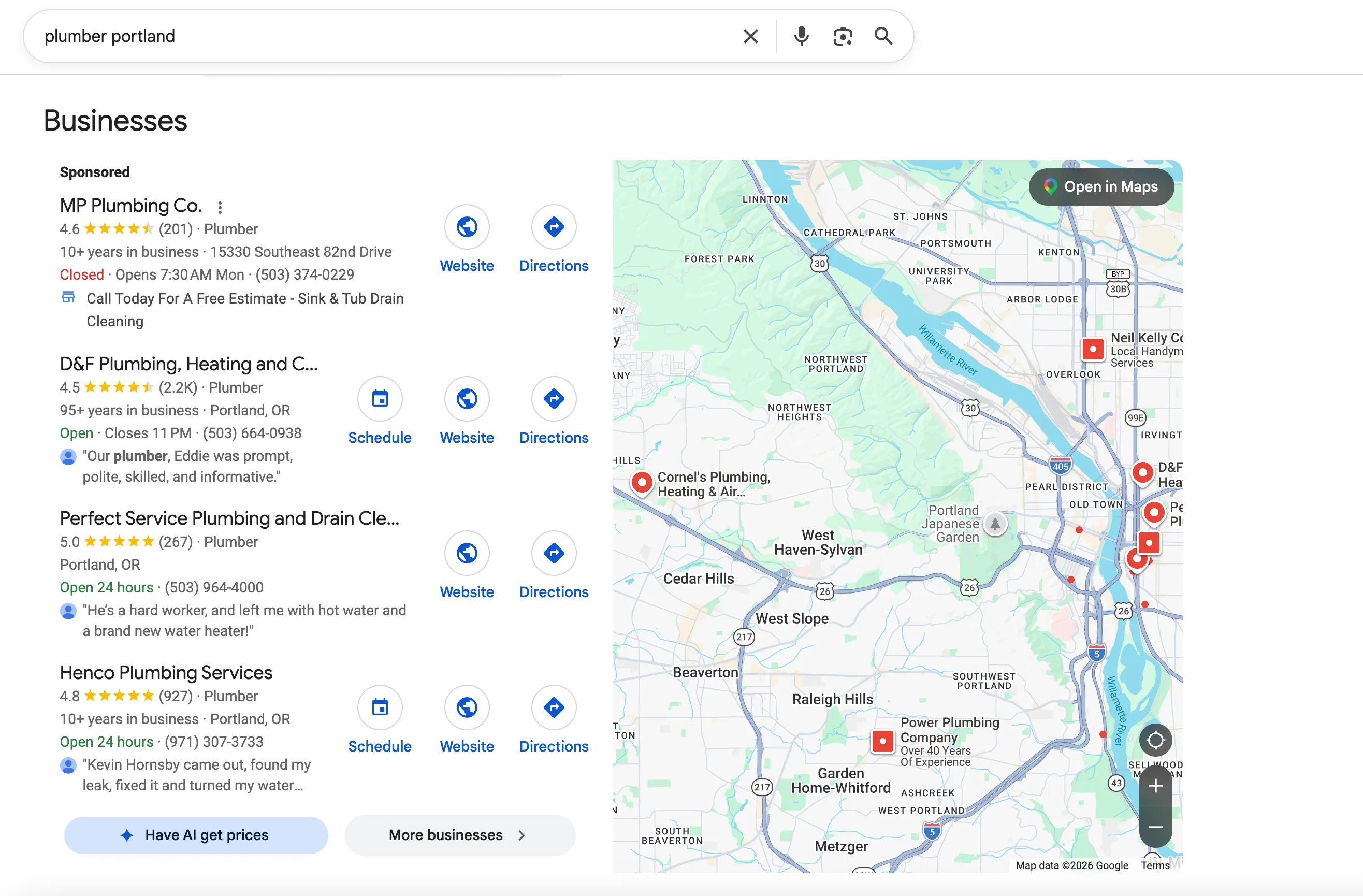
For a trade, SEO is still where the phone rings. The searches that produce a call are the ones with a map on them, and those searches show a map.
Ahrefs, US, September 2026: "roofing companies near me" is 132,000 searches a month. "Plumber near me" is 414,000. "Electrician near me" is 214,000. Every one of them returns a three-pack of local businesses first. In Portland, "plumber portland" is 900 a month and a plumber pays $25 a click to buy the position the top three hold for free. None of those results carries an AI Overview. Someone with a leaking water heater wants a phone number, and Google still gives them a map.
So the foundation does not change. A fast site with a page per service and a page per city, a complete Google Business Profile, reviews that keep coming, and listings that agree with each other. That is what the map runs on. It is also most of what the AI runs on for a best-in-city question. GEO for contractors has the five inputs by trade.
Where AEO sits
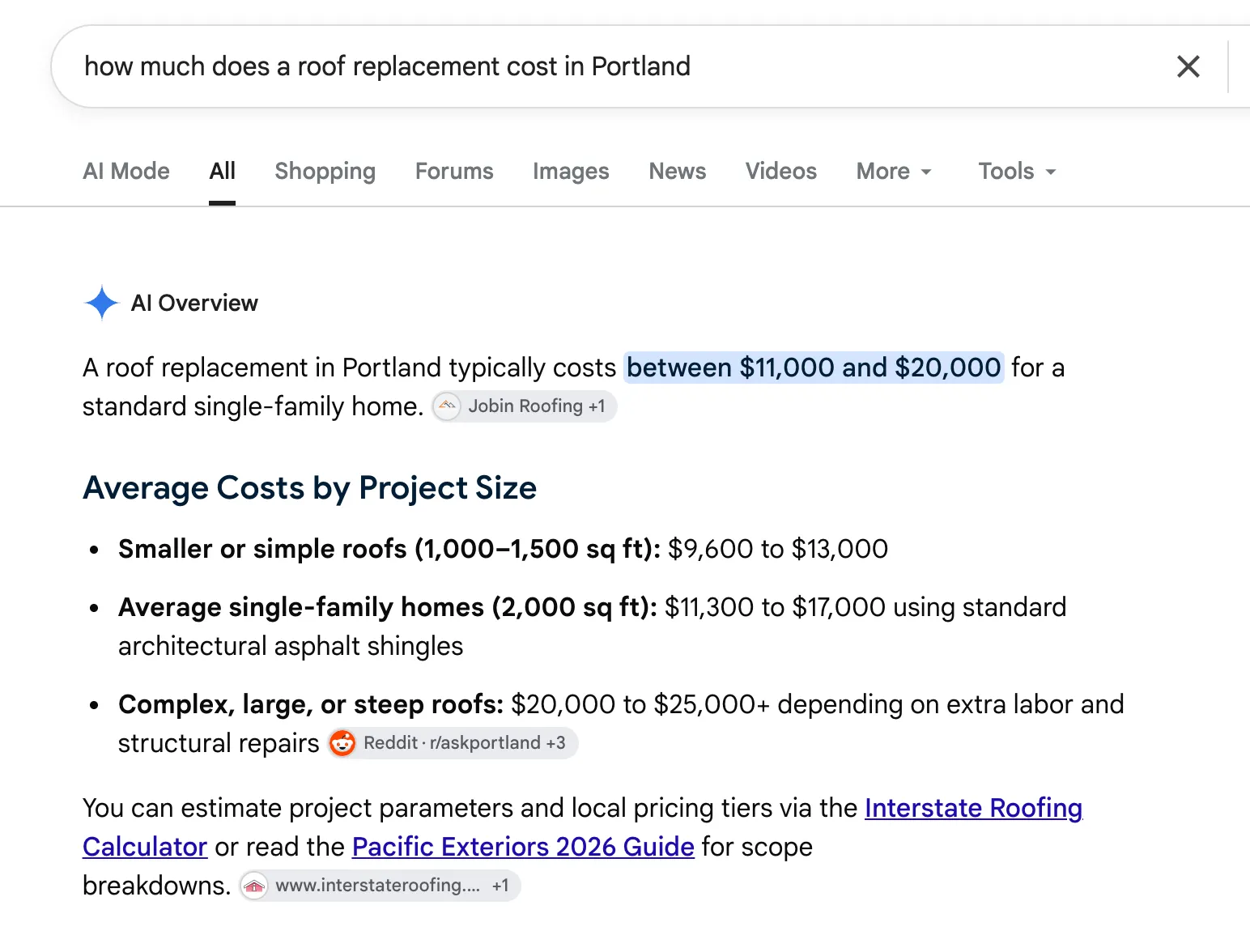
AEO is about the questions. "How much does a roof replacement cost in Portland." "Do I need a permit to replace a water heater in Oregon." "How long does an electrical panel upgrade take." Those searches do get an answer box, and increasingly an AI Overview, and the box is built from pages that answer plainly.
The searches about hiring an SEO agency for a trade show the same thing. "SEO for contractors" returns an AI Overview at the top of the page that cites nine sources before a single blue link appears. The businesses cited are the ones whose pages answer the question in the first sentence under a heading that is the question.
AEO, in practice, is a writing discipline. Put the question in the heading. Answer it in the first sentence. Give the number, the range, or the yes or no. Then explain. Mark the page up with FAQ schema so the engine can see the pairs. That is the whole technique, and most contractor sites do none of it.
What GEO changes
A generative engine does not rank pages. It reads what it can find about a business, decides what it can verify, and writes. That changes who wins.
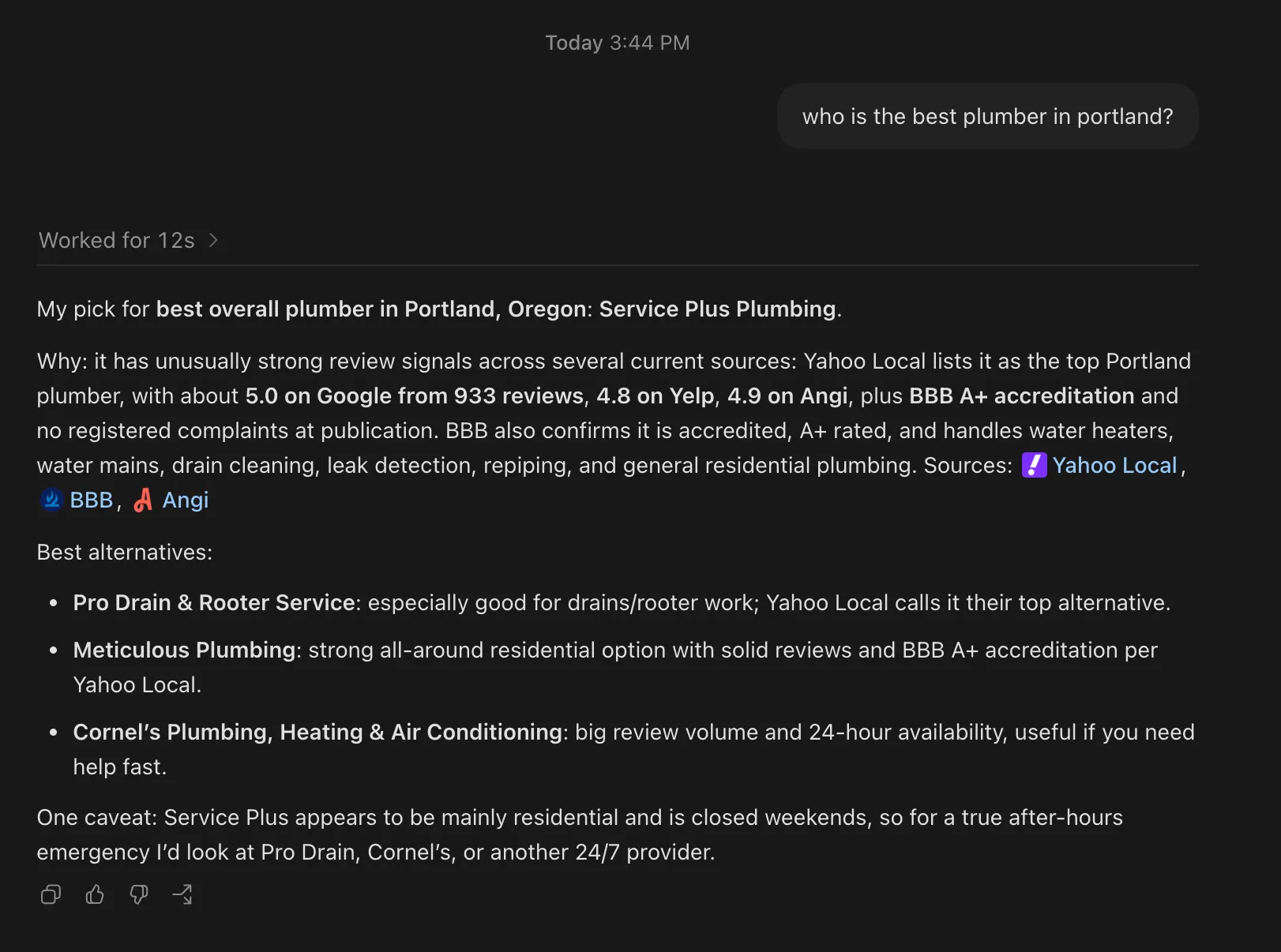
Two examples from Portland, captured on September 6, 2026. Asked "who is the best roofer in Portland, Oregon," ChatGPT named Interstate Roofing. Interstate is not in Google's three-pack for "roofers portland." The answer cited the BBB profile, an Expertise listing, a Birdeye review count, and for the runner-up the Oregon CCB license record. Asked the same about plumbers, it named Service Plus Plumbing, also absent from the pack, citing Yahoo Local, BBB, and Angi. Then it added a caveat: Service Plus closes on weekends, so for an emergency it pointed to a 24-hour provider instead.
Read those two answers as instructions. The AI named the business it could confirm from several independent sources. It repeated facts it found on third-party pages, including hours. It named the business with the longest consistent record and the largest review base, and neither of them was in the map. Nothing about Maps position entered into it. The week of work that gets ChatGPT to recommend a business is those instructions in order.
This matches the research. The paper that named the field, "GEO: Generative Engine Optimization" from researchers at Princeton, Georgia Tech, and IIT Delhi in 2023, tested what makes a source more likely to be used in a generated answer. Adding citations, quotations, and statistics raised visibility by up to 40 percent in their benchmark. Keyword stuffing did nothing. Specific, verifiable, well-sourced content won.
GEO vs AEO
People use the two interchangeably, and they are close. The difference is the shape of the request.
AEO answers a question someone typed. The output is a fact or a short explanation, and the win is being the source it came from. GEO is being the recommendation inside an answer that may have no question shape at all: "find me a roofer," "which plumber should I call," "plan my kitchen remodel." The engine has to decide who to name, and it names who it can verify.
Both reward the same underlying thing: specific, consistent, checkable information about your business, on your site and everywhere else. If you do the work for one, you have done most of the work for the other.
Why content-rich sites win all three
An engine can only repeat what exists. A site with a home page, an about page, and a gallery gives it nothing to repeat. A site that says what it does, where, for how much, under what license, with what warranty, and at what hours, gives it everything.
"Content-rich" does not mean a blog with sixty posts. For a contractor it means the facts a customer would ask on the phone, written down on pages an engine can read. Here is what that looks like.
- A page per service. Roof repair, moss removal, metal roofing, gutters. Each with the process, the timeline, the price range, and the questions people ask. One "services" page with a list of nouns is not a page per service.
- A page per city you work in. Beaverton, Gresham, Lake Oswego, Vancouver. Real content about working there, with the jobs, the photos, and the streets you know.
- The facts, in text. CCB number, insurance, warranty terms, hours, service area, the year you started. On the site, in the profile, on BBB, on Yelp, on Angi, and identical everywhere. The AI checked Service Plus's hours. It will check yours.
- Answers to the ten questions. The ones customers ask before they book. Written as a question and a plain answer, with FAQ schema on the page.
- Proof someone else wrote. Reviews on the profile, a BBB listing, an association membership, a mention in a local publication. Every answer in the examples above was built from third-party sources alongside the business's own site.
- A site that loads. Engines crawl what they can reach quickly. A slow site on an old builder gets read less often and less deeply.
What to do first, in order
This is the order I use, because each step makes the next one worth more.
- 1. Fix the facts. Name, address, phone, hours, and license number, identical on the site, the Google profile, BBB, Yelp, Angi, and the state license lookup. Disagreements are what an engine trips on.
- 2. One page per service, one per city. This is the SEO work and the GEO work at the same time. The map pulls from these pages, and so does the AI.
- 3. Answer the questions. A page or a section for each of the questions customers ask, with FAQ schema. This is the AEO work.
- 4. Get cited. BBB accreditation, the trade association, the chamber, the local paper, the supplier's installer directory. Each is a source an engine can use to confirm you exist and are what you say.
- 5. Measure it. Once a month, ask ChatGPT, Gemini, and AI Mode the questions your customers ask, and write down who gets named. Watch referrals from chatgpt.com and perplexity.ai in your analytics. Track the map and the calls as before. That is the monthly AI visibility check in full.
The honest caveat
As of September 2026, the map still produces most of the calls for a Portland trade, and the AI answers produce a growing share of the research that leads to them. The share is moving in one direction. The work that wins the AI answer is the same work that holds the map, done more thoroughly and written down more plainly. There is no separate GEO trick to buy. There is a site with more to say, and facts that agree. The free consultation shows which of the three you are missing today.
Frequently asked questions
- Is GEO replacing SEO?
- No. For local trades the searches that produce calls still show a map, and the map runs on SEO. GEO is being named when someone asks an AI for a recommendation, and it is built on the same foundation: specific pages, consistent facts, and third-party mentions. Do the foundation once and both benefit.
- How do I rank in ChatGPT?
- There is no ranking to hold. ChatGPT names businesses it can verify from several sources. Make the facts about your business identical everywhere, get listed on BBB and the trade directories, keep the state license record current, and put a page on your site for each service and each area. Then ask it monthly and see whether you are named.
- How do I get recommended by ChatGPT as a local business?
- The Portland examples show the pattern. It named the roofer with a BBB profile, a CCB record, and consistent reviews across sources, and it named the plumber that Yahoo Local, BBB, and Angi all agreed on. Be that business: verifiable from outside your own site, with hours and services that match everywhere.
- What is the difference between GEO and AEO?
- AEO is answering a question someone typed, so a snippet or an AI Overview quotes you. GEO is being the recommendation inside an answer an AI writes, even when the request has no question shape. Both reward the same specific, checkable content, so the work overlaps almost entirely.
- Does GEO matter for a small contractor in Portland?
- Yes, and it is cheaper to win now than it will be. Almost no Portland contractor is doing it on purpose, which is why a roofer with no map position is currently the AI's first pick. The work is the same foundation work the map needs, written down more completely.
Ask the engines about your business.
The consultation runs the searches and the prompts for your trade and shows you where you show up and where you don't. The consultation is free, and the pricing is published.