What custom inventory software actually means
Custom inventory management software is software built around one business's specific workflow, data model and channel mix, rather than a general-purpose product configured to approximate them. The business usually owns the code outright and runs it on its own accounts.
That last part matters more than it sounds. A custom tool that lives on a vendor's infrastructure with a monthly fee attached is just SaaS with extra steps. Owning the code means the tool doesn't disappear when a company gets acquired or changes its pricing. That is the standard for the software I build for stores.
The four situations that justify building
Each of these is a case where configuration stops being enough and you end up maintaining a workaround forever instead.
- Your workflow doesn't match the product's assumptions. every inventory product encodes assumptions: one warehouse or many, one channel or several, items or variants, receipt-based costing or average costing. When your operation contradicts a core assumption, configuration doesn't save you. The clearest symptom is someone on your team maintaining a spreadsheet that reconciles the software's output with reality: that spreadsheet is the specification for a tool that should exist.
- The answer requires joining data no single vendor holds. your warehouse system knows on-hand and cost. Your storefront knows orders and prices. Each marketplace knows its own sales, fees and returns. Your shipping platform knows actual label cost. The question you want answered, which variants are aging, on which channel, at what true margin after everyone takes their cut, requires all of it at once. No vendor has access to all of it, so no vendor sells the report. This is why the same businesses keep rebuilding the same spreadsheet: the join is the product.
- Subscription cost has outgrown build cost. per-seat and per-order pricing scales with your success. At some volume the multi-year total exceeds the cost of building the specific thing you use it for. Be honest in the comparison: most SaaS does far more than you use, so the right question isn't what the platform costs, it's what it would cost to build the 15% of it you actually touch.
- The tool would change how you work, and you don't want it to. products come with an opinion about how the job should be done. Sometimes their opinion is better than yours and adopting it is the upgrade. Sometimes your process is a genuine advantage: a buying method, a markdown discipline, a way of routing orders, and adopting the product's opinion would flatten it. If your process is the edge, don't buy software that erases it.
The four situations where you should buy instead
The honest inverse. Any of these and building is the wrong call.
- Your workflow is standard. if you sell on one or two channels from one location with normal costing, the market has solved this. Pay for it.
- You need it next week. building takes time, buying takes an afternoon. Urgency is a legitimate reason to buy something imperfect.
- The problem isn't well understood yet. if you can't describe the workflow precisely, you're not ready to have it built. Building crystallises a process, which is a problem if the process is still moving. Use an off-the-shelf tool until you know what you actually do.
- It's regulated, security-critical, or a commodity. payments, tax calculation, accounting ledgers, carrier rating. These have expensive compliance surfaces and mature vendors. Build nothing here.
What it costs and what to demand
Custom development has a reputation for open-ended budgets, and often deserves it. The structural fixes are straightforward, and you should insist on all four.
The comparison that matters isn't build cost against zero. It's build cost against the multi-year subscription total plus the labour currently spent on manual workarounds. That second term is usually the larger one and it's almost never counted, because it's distributed across people who've stopped noticing they do it.
- Fixed price, quoted before work starts. if a scope can't be priced, it isn't scoped. Hourly billing on an unscoped project transfers all the risk to you.
- You own the code. in your repository, under your license, with no ongoing dependency on the person who wrote it. This is the single most important term and the one most often quietly omitted.
- It runs on your accounts. your database, your API credentials, your infrastructure. If the tool stops working because a relationship ended, you rented rather than bought.
- Narrow scope. one painful workflow done properly beats a platform that does six things adequately. Narrow scope is also what makes fixed pricing possible.
What a scoped build looks like in practice
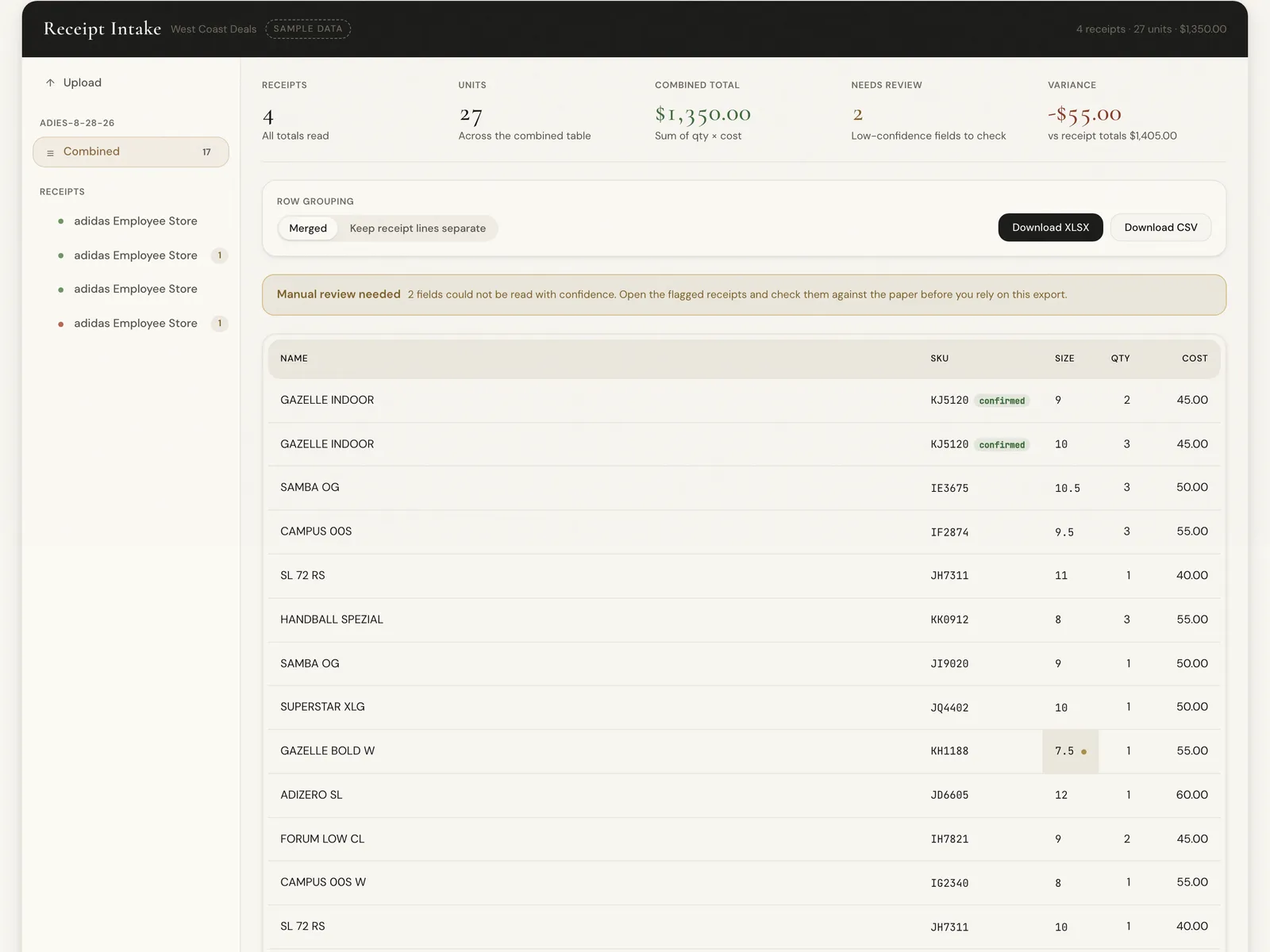
A real example rather than a hypothetical one. A multi-channel apparel and footwear operation needed to know which variants were aging and what to do about them. The data existed, in a warehouse system, a storefront, and a stack of marketplace exports that didn't agree on SKU format.
The tool scores every variant on age, velocity and days of supply, then applies a markdown ladder automatically: full price through day 45, −10% at day 46, −20% at day 61, clear past 90, with a cost-basis check so nothing drops below its floor, and a velocity exemption so fast movers are never marked down for being old.
Result: the long tail gets marked down every day instead of once a season. technically remarkable. The work was the join, the SKU normalisation, and encoding decisions the operator was already making by hand.
How to decide
A rough test. Count how many of these are true.
Zero to one: buy. Two to three: worth pricing a narrow build against your current spend. Four or five: you already know, and the cost of not building is showing up in your margin rather than on an invoice. The free consultation counts them for you and prices the manual work.
- Someone maintains a spreadsheet to reconcile your software's output with reality.
- The report you most want requires data from three or more systems.
- You've evaluated products and each one fails on a different requirement.
- Manual work you could describe precisely consumes hours every week.
- Your subscription costs scale with volume and you're growing.
Frequently asked questions
- What is custom inventory management software?
- Software built specifically around one business's inventory workflow, data model and channel mix, rather than a general-purpose product configured to approximate it. The business typically owns the code and runs it on its own accounts and infrastructure.
- When is custom inventory software worth building instead of buying?
- When your workflow is genuinely non-standard, when the reporting you need requires joining data that no single vendor has access to, when per-seat or per-order SaaS pricing has outgrown the cost of building, or when the off-the-shelf option would require changing how the business operates rather than supporting how it already does.
- How much does custom inventory management software cost?
- It varies with scope, but the meaningful comparison is against the multi-year total of the SaaS it replaces plus the labour currently spent on manual workarounds. A well-scoped internal tool is usually a fixed-price project rather than an open-ended engagement, and it should be quoted before any work starts.
- What are the risks of building custom software?
- The real risks are scope creep, dependency on a single developer, and building a tool nobody adopts. All three are addressed the same way: scope narrowly to one painful workflow, own the code outright, and build for the person who actually does the job.
- Should a small business build custom inventory software?
- Usually not as a first move. If off-the-shelf covers your workflow and the subscription cost is modest, buy it. Custom becomes reasonable when you have specific, repeated, expensive manual work that no product on the market addresses.
- What's the difference between custom software and a custom integration?
- An integration moves data between existing systems. Custom software makes decisions with that data. Many businesses need the first and describe it as the second, which is worth clarifying before anyone quotes.
What I do
I help businesses fix what stops them growing: being found on Google and in AI answers, a site that turns visits into calls and orders, and the software when the process needs it. I build that software for multi-channel e-commerce and retail operators: inventory, pricing and margin tools built around a business's own data, at a fixed price, with the client owning the code and running it on their own accounts. Built by an operator who runs the process. Scoping is free and it ends in a fixed price or an honest recommendation to buy something instead.